Understanding Market Manipulation: Theory and Practice

A Teach-In Event for the FCA Tech Sprint on Market Abuse Surveillance

Key Takeaways

  • Understand the basic mechanics of financial markets and how trader activity influences prices
  • Gain insights into the various types of market manipulation and the legal framework surrounding them
  • Explore the theories behind market manipulation, including microstructure, information-based, and behavioural finance theories
  • Learn from real-world case studies, both historical and contemporary, to see market manipulation in action
  • Discover the importance of market abuse surveillance and learn about techniques for detecting and preventing market manipulation

How Trader Activity Informs Market Prices:

Econ 101 View

  • Price Discovery Process
  • Continuous interaction of buyers and sellers
  • Prices adjust as new information becomes available
  • Efficient markets hypothesis: prices reflect all available information

How Trader Activity Informs Market Prices:

Econ 101 View

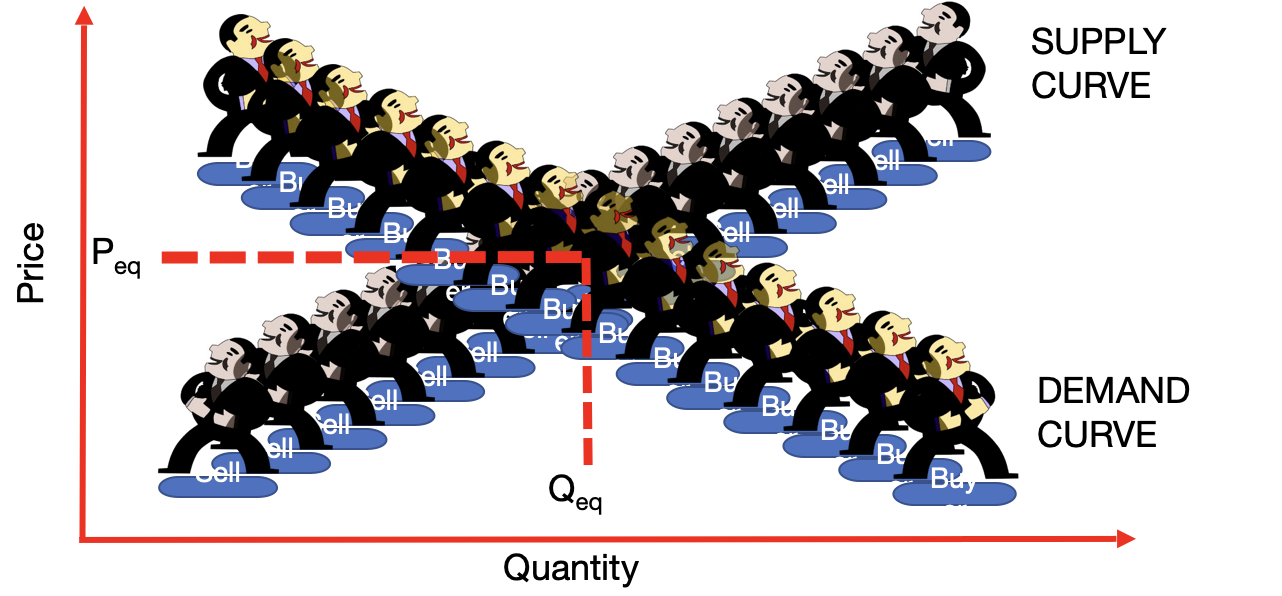
  • Supply and Demand Dynamics
    • Supply: Sellers willing to sell at various price points
    • Demand: Buyers willing to buy at various price points
    • Equilibrium price: Where supply meets demand
  • Atomised View of Trader Activity

How Trader Activity Informs Market Prices

The Trading Paradox
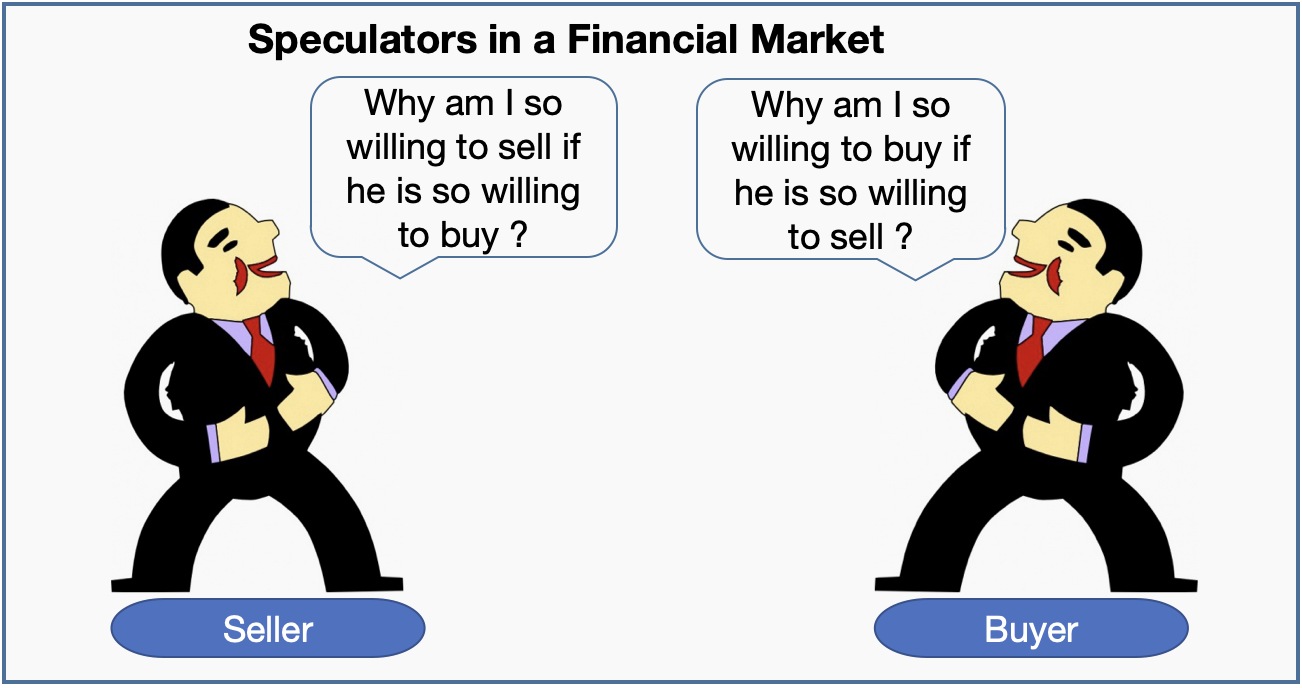
  • High trading volume seems paradoxical
    • Rational traders should be skeptical of willing counterparties
    • “Why is the other party willing to trade with me?”
  • Yet, we observe high turnover in financial markets
  • This paradox challenges our understanding of price formation

UK Market Daily Trading Volume Statistics

London Stock Exchange (LSE)

  • Average daily trading volume (2020): 1.5 billion shares
  • Average daily trading value (2020): £5.2 billion (USD $7.2 billion)

Source: London Stock Exchange Group, “Annual Report 2020”

FTSE 100 Index

  • Average daily trading volume (2020): 1.1 billion shares

Source: London Stock Exchange Group, “FTSE 100 Index Factsheet”

Foreign Exchange (Forex)

  • London’s share of global forex trading (April 2019): 43%
  • Average daily turnover in UK forex market (April 2019): $2.7 trillion

Source: Bank for International Settlements (BIS), “Triennial Central Bank Survey of Foreign Exchange and Over-the-counter (OTC) Derivatives Markets in 2019”

Resolution: Three Key Market Participants
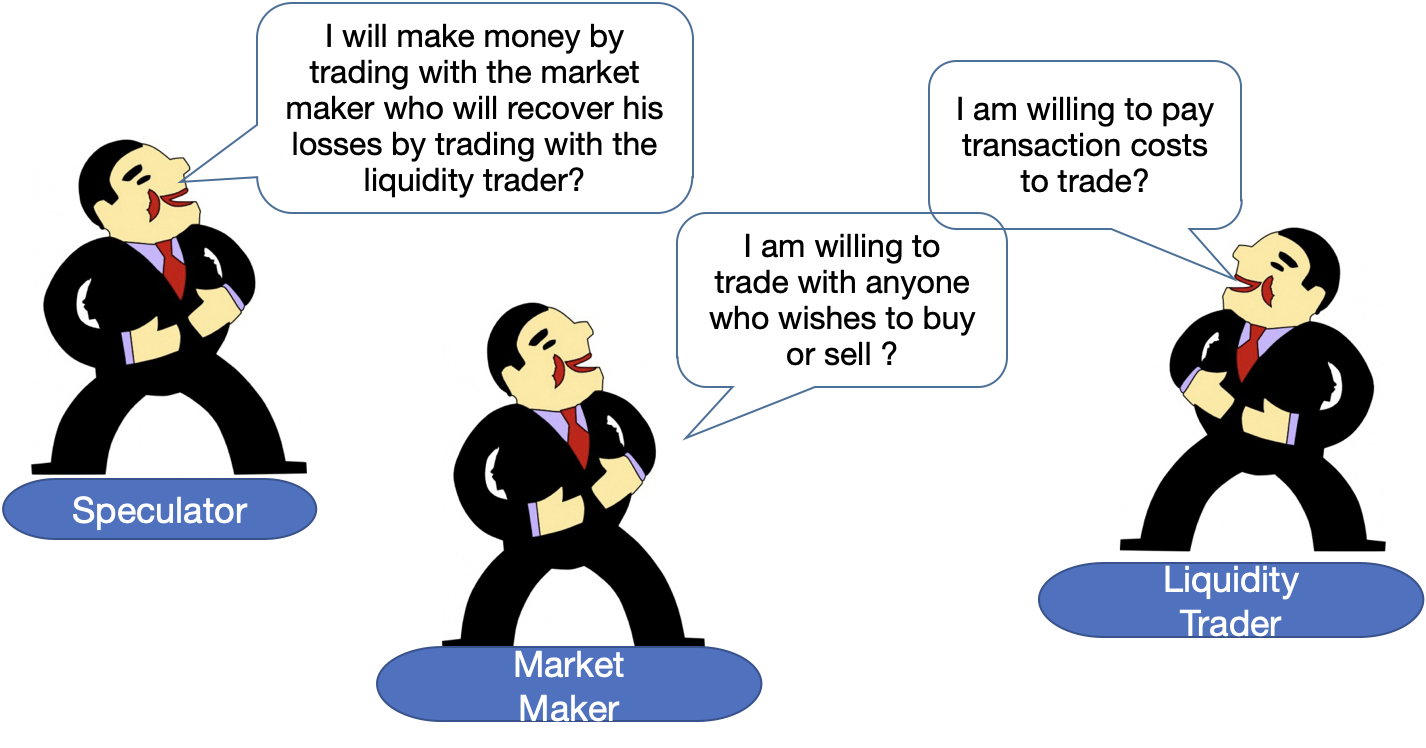
  1. Liquidity Traders
    • Trade for non-information reasons (e.g., cash needs, rebalancing)
    • Willing to pay transaction costs to meet trading needs
  2. Market Makers
    • Provide liquidity by always being willing to buy or sell
    • Profit from the bid-ask spread
    • Lose to informed traders, but recover losses from liquidity traders
  3. Speculators (Informed Traders)
    • Trade based on information or analysis
    • Profit from trading against less informed participants

The Three-Legged Stool of Market Function

  • Each participant type is crucial, like legs of a stool:
    • Without market makers: No consistent counterparty
    • Without liquidity traders: Market makers would exit
    • Without speculators: Prices may not reflect information
  • This interaction resolves the trading paradox
    • Liquidity traders create initial demand for trading
    • Market makers provide necessary liquidity
    • Speculators ensure prices reflect available information

Price Formation Process

  • Liquidity traders initiate trades based on non-information needs
  • Market makers set bid-ask spreads to balance risks
  • Speculators trade when they perceive mispricing
  • Interaction of all three groups leads to price discovery
  • Prices continuously adjust as new information becomes available
  • Result: Prices reflect a balance of information and liquidity needs
  • Trading volume is driven by the interaction of all three participant types

Implications for Market Efficiency

  • Econ 101 breaks down and Traders’ actions become strategic and affect how prices are formed
  • Order Imbalance Simulation link
  • Price efficiency depends on the presence and activity of all three groups
  • Market structure influences how quickly and accurately prices adjust
  • The Efficient Market Hypothesis relies on this delicate balance
  • Understanding this process is crucial for:
    • Designing robust market mechanisms
    • Detecting and preventing market manipulation
    • Ensuring fair and efficient price formation

How Trader Activity Informs Market Prices:

A Model

  • Glosten and Milgrom (1985) model was designed to study the impact of insider trading on market pricing and liquidity
  • Key insights:
    • Presence of informed traders (insiders) affects bid-ask spreads
    • Market makers widen spreads to compensate for adverse selection risk
    • Insider activity can move prices to the bid or ask

Glosten-Milgrom Model Simulation

  • Demonstrates the impact of informed trading on prices and spreads
  • User inputs:
    • Number of traders
    • Number of insiders
    • Number of trading rounds
  • App logic:
    • Generates insider orders (biased) and noise orders
    • Calculates bid-ask spread based on insider proportion
    • Determines price based on order imbalance
    • Outputs price series and bid-ask spread series
  • Access the web app: link

Defining Market Manipulation

  • What is Market Manipulation?
    • Intentional conduct designed to deceive investors
    • Creating false or misleading appearance of trading activity
    • Artificially influencing market price or trading volume
  • Types of Manipulation
    • Trade-based: Wash trading, spoofing, layering
    • Information-based: False rumors, misleading reports
  • Legal Framework
    • Securities Exchange Act of 1934 (US)
    • Market Abuse Regulation (EU)
    • Financial Services and Markets Act 2000 (UK)
    • Regulatory bodies: SEC, FCA, ESMA

Theories of Market Manipulation

Case Studies

  • Libor Scandal
    • Banks submitting false rates for profit
    • Resulted in billions in fines, criminal charges
    • Exposed vulnerability of self-reported benchmarks
  • Enron Scandal
    • Accounting fraud and energy market manipulation
    • Led to company bankruptcy, executive prosecutions
    • Highlighted importance of corporate governance
  • GameStop Short Squeeze (2021)
    • Coordinated retail buying via social media
    • Caused significant losses for short-selling hedge funds
    • Raised questions about market fairness and regulation
  • Cryptocurrency Manipulation
    • Pump and dump schemes, wash trading common
    • Bitfinex/Tether controversy: alleged Bitcoin price manipulation
    • Challenges of regulating decentralized markets
    • Pump and Dump Simulation link

Using the Glosten-Milgrom Model to Understand Market Manipulation

  • Information-based manipulation
    • Manipulator acts as “insider” with false information edge
    • Creates artificial information asymmetry to mislead traders
  • Spoofing and layering
    • Manipulator places orders to create false demand/supply
    • Drives price to bid or ask, then reverses position
  • Wash trading
    • Manipulator trades with self to generate artificial volume
    • Appears as high “insider” activity, widening spreads
  • Collusion and pooling
    • Manipulators coordinate to act as a large informed trader
    • Model suggests higher informed trading leads to wider spreads, more price impact

Limitations

  • Glosten-Milgrom model assumptions:
    • Insiders trade on genuine information
    • Doesn’t fully capture complex manipulation tactics
  • Extending the model:
    • Explicitly model manipulative strategies
    • Incorporate cross-market effects
    • Consider regulatory detection and enforcement
  • Empirical testing:
    • Validate model predictions using real manipulation cases
    • Assess effectiveness of the model in detecting manipulation

Detecting and Preventing Market Manipulation

  • Market Abuse Surveillance
    • Critical for maintaining market integrity
    • Required by regulations (MiFID II, Dodd-Frank)
  • Detection Techniques
    • Machine learning and AI for anomaly detection
    • Time series analysis (e.g. volatility clustering, regime switching)
    • Network analysis
    • Real-time monitoring of trading activity and news
  • Prevention Best Practices
    • Robust compliance frameworks and internal controls
    • Regular education and training for market participants
    • Fostering an ethical trading culture

Conclusion

  • Market manipulation disrupts the delicate balance of the three-legged stool
  • Understanding manipulation is crucial for preserving market integrity
  • Multi-faceted approach needed: technology, regulation, education
  • Future challenges:
    • Emerging technologies (AI, blockchain)
    • Cross-border and cross-asset manipulation
    • Decentralised finance and social media influence
  • Robust benchmark design is critical in mitigating manipulation risks and maintaining fair price formation

EXTRAS

Glosten Milgrom Mathematical Exposition

  • \(V\): The true value of the asset, which can be either low (\(V_L\)) or high (\(V_H\))
  • \(P_t\): The market maker’s price at time \(t\)
  • \(X_t\): The trade indicator at time \(t\) (+1 for a buy, -1 for a sell)
  • \(\mu\): The fraction of informed traders in the market
  • \(\lambda\): The probability that an informed trader observes \(V_H\)

The model assumes that:

  1. Informed traders buy when \(V = V_H\) and sell when \(V = V_L\)
  2. Uninformed traders buy and sell with equal probability

Given these assumptions, the market maker’s pricing rule is:

\(P_t = E[V | X_1, X_2, ..., X_{t-1}]\)

This means that the market maker sets the price equal to the expected value of the asset conditional on the history of trades.

Using Bayes’ rule, we can express the price as:

\(P_t = \frac{P(X_1, X_2, ..., X_{t-1} | V = V_H) \cdot P(V = V_H)}{P(X_1, X_2, ..., X_{t-1})}\)

The bid-ask spread at time \(t\) is given by:

\(S_t = P_t^a - P_t^b = \frac{\mu(1 - \lambda)}{\mu(1 - \lambda) + (1 - \mu)/2} (V_H - V_L)\)

where \(P_t^a\) is the ask price and \(P_t^b\) is the bid price.

The key insights from this formalization are:

  1. The market maker’s price is a function of the trading history, reflecting the information content of past trades
  2. The bid-ask spread is directly proportional to the fraction of informed traders \(\mu\) and the asset’s value uncertainty \((V_H - V_L)\)
  3. As the fraction of informed traders increases, the bid-ask spread widens to compensate for the increased adverse selection risk faced by the market maker
  • This formulation provides a rigorous foundation for understanding how informed trading affects market pricing and liquidity in the Glosten-Milgrom model.

References

Aggarwal, Rajesh K, and Guojun Wu. 2006. “Stock Market Manipulations.” The Journal of Business 79 (4): 1915–53.
Allen, Franklin, and Douglas Gale. 1992. “Stock Price Manipulation.” The Review of Financial Studies 5 (3): 503–29.
Barberis, Nicholas, and Richard Thaler. 2003. “A Survey of Behavioral Finance.” In Handbook of the Economics of Finance, 1:1053–1128. Elsevier.
Benabou, Roland, and Guy Laroque. 1992. “Using Privileged Information to Manipulate Markets: Insiders, Gurus, and Credibility.” The Quarterly Journal of Economics 107 (3): 921–58.
Glosten, Lawrence R, and Paul R Milgrom. 1985. “Bid, Ask and Transaction Prices in a Specialist Market with Heterogeneously Informed Traders.” Journal of Financial Economics 14 (1): 71–100.
Kyle, Albert S. 1985. “Continuous Auctions and Insider Trading.” Econometrica 53 (6): 1315–35.
Mei, Jianping, Guojun Wu, and Chunsheng Zhou. 2004. “Behavior Based Manipulation: Theory and Prosecution Evidence.” Available at SSRN 457880.
Meulbroek, Lisa K. 1992. “An Empirical Analysis of Illegal Insider Trading.” The Journal of Finance 47 (5): 1661–99.
Shleifer, Andrei. 2000. Inefficient Markets: An Introduction to Behavioral Finance. Oxford University Press.
Van Bommel, Jos. 2003. “Informed Trading, Market Manipulation and Price Volatility.” Journal of Financial Intermediation 12 (3): 201–27.